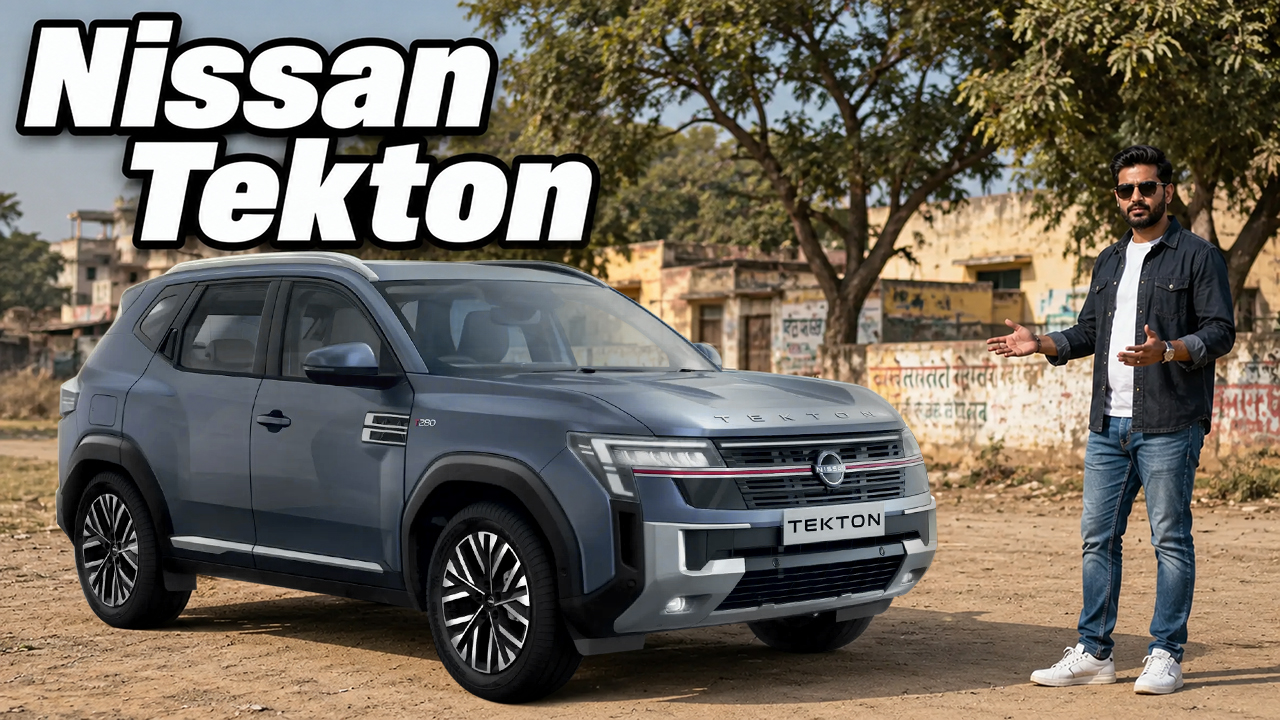
Nissan Tekton: For a long time, Nissan has relied mainly on the Magnite to maintain its presence in the local SUV market. In the mid-size class led by the Hyundai Creta and Kia Seltos, the brand has lacked a model with enough substance to compete at the centre of the segment. The Tekton is designed to fill that gap. It shares its platform with the Renault Duster, but separates itself through Patrol-inspired styling, the stronger T280 engine and a five-star Bharat NCAP safety rating. At the same time, its compromises are equally clear, with no hybrid across the range and no automatic gearbox for the T160.
Which engine and variant make the most sense, and does the Tekton offer enough to bring Nissan back into mainstream consideration? Let us take a closer look.
Design: Familiar Proportions, Distinct Nissan Character
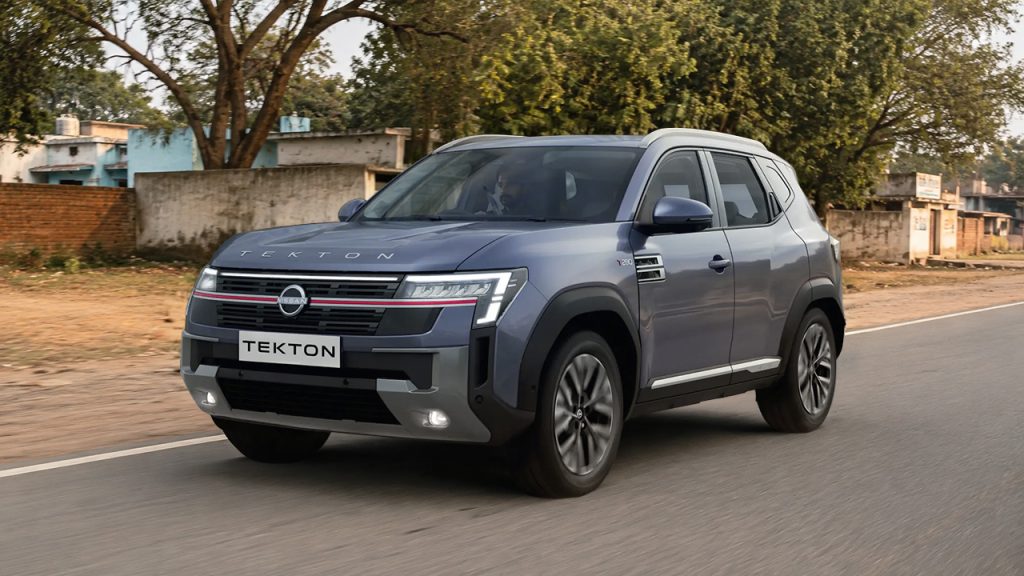
The Nissan Tekton has the tall bonnet, broad shoulders and squared-off profile expected from a traditional SUV. The basic shape remains familiar, but the detailing gives it a noticeably different character.
- Patrol Influence: The wide chrome grille, upright bonnet, pronounced wheel arches and available 18-inch alloy wheels give the Tekton the visual confidence associated with Nissan’s larger SUVs.
- Lighting Design: C-shaped LED elements create a consistent theme at both ends, while N-Connecta and higher variants receive connected front and rear lighting.
- Ground Clearance: The 212mm clearance should prove useful on broken roads, tall speed breakers and steep entrances.
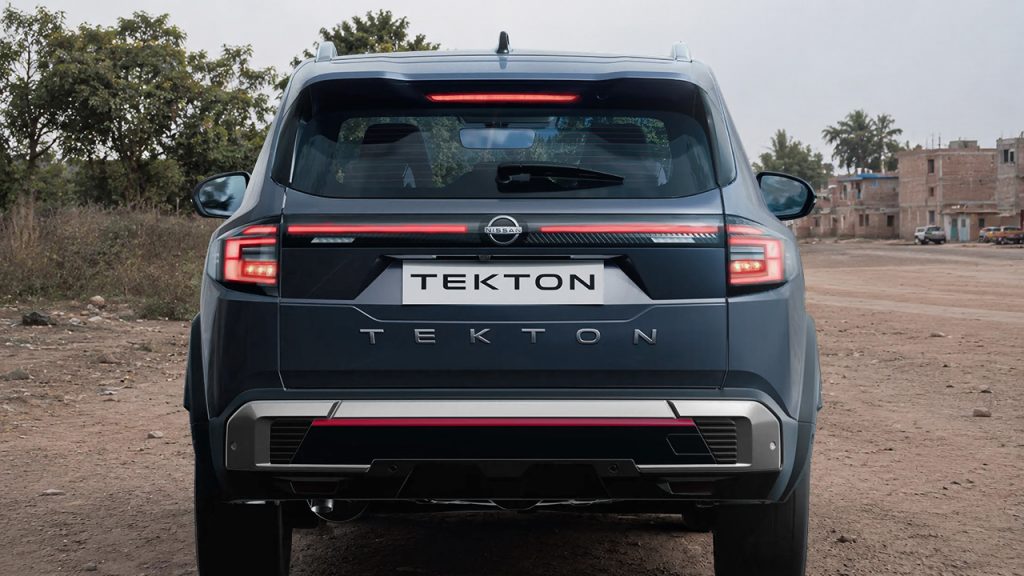
Despite the familiar proportions, the Tekton has enough Nissan character to stand apart from the Duster.
Cabin: A Clear Step Beyond Nissan’s Entry-Level Image
The cabin shows how far the Tekton moves beyond Nissan’s current entry-level offerings. A raised centre console and wraparound dashboard give the front compartment more structure, while physical controls remain for commonly used functions.
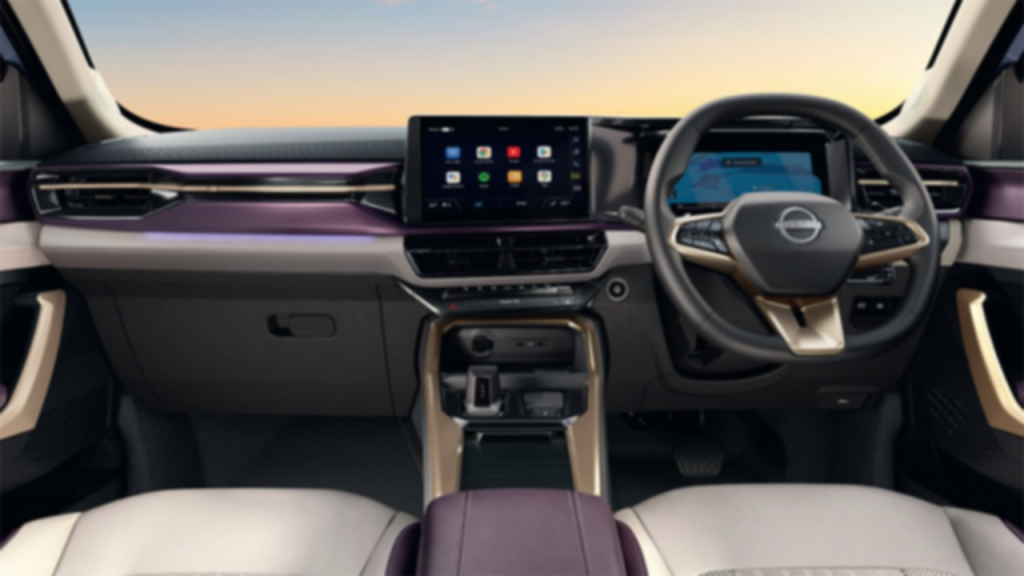
- Displays and Controls: Higher variants combine a 10.1-inch infotainment screen with a 10.25-inch digital instrument cluster. The dual-screen layout looks modern without removing the physical controls needed for quick adjustments.
- Comfort: N-Connecta introduces the panoramic sunroof and dual-zone climate control, while Tekna adds ventilated front seats and powered driver adjustment.
- Connectivity: Wireless Android Auto and Apple CarPlay are available from Visia+. Google built-in remains exclusive to Tekna+, but its native Maps, Assistant and Play Store support feels more integrated than a basic smartphone-mirroring setup.
- Family Practicality: The boot holds 518 litres below the parcel shelf and reaches 700 litres when loaded to the roof. Its upright shape gives families useful space for large suitcases, airport runs and longer road trips, while a 60:40 split rear seat is offered from Acenta.
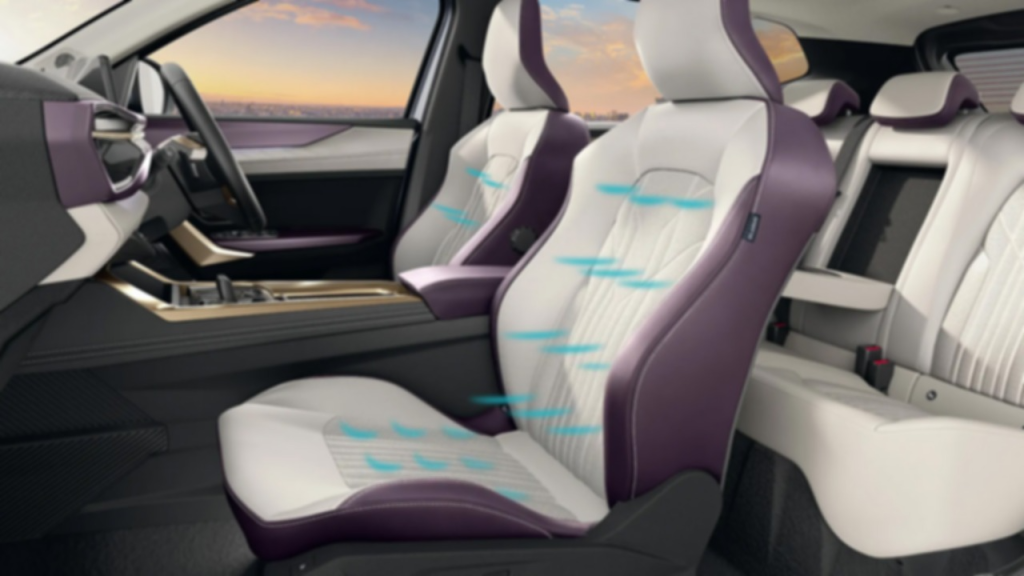
Lower trims remain usable, but N-Connecta is where the Tekton begins to feel properly complete. Tekna adds the more desirable comfort and safety features, while Tekna+ focuses on technology and convenience.
Powertrain: T160 or T280?
Every Nissan Tekton uses a turbo-petrol engine. The smaller T160 keeps the starting price and claimed fuel consumption lower, while the T280 provides substantially stronger performance and the only automatic option in the range.
| Feature | 1.0L T160 Turbo-Petrol | 1.3L T280 Turbo-Petrol | Key Difference |
|---|---|---|---|
| Power | 100PS | 163PS | T280 offers a clear performance increase |
| Torque | 166Nm | 280Nm | T280 is better suited to passengers and luggage |
| Transmission | 6-speed manual | 6-speed manual or 6-speed wet-clutch DCT | Only T280 offers an automatic |
| Claimed Efficiency | 19.4km/l | 17.8km/l MT, 18.5km/l DCT | T160 has the efficiency advantage |
- Choose the T160: It suits buyers who mainly drive in the city, prefer a manual gearbox and want to keep the purchase price under control. Its claimed efficiency is better, but the lack of an automatic limits its appeal in heavy traffic.
- Choose the T280: This is more than simply the faster engine. Its 163PS and 280Nm better match the Tekton’s size, especially with passengers and luggage on board. The optional wet-clutch DCT also makes it the more convincing choice for highway use and congested commutes.
The main gap in the powertrain range is the absence of a hybrid. That gives the strong-hybrid versions of the Grand Vitara and Hyryder an advantage for buyers who prioritise fuel economy, although the Tekton T280 offers substantially stronger turbo-petrol performance.
Safety, Pricing and the Versions to Consider
The Tekton carries a five-star Bharat NCAP rating based on the assessment of the structurally identical Renault Duster. Six airbags and more than 40 safety features are standard across the range. Tekna introduces the main ADAS package, while Tekna+ adds the wider driver-assistance suite and the 3D Around View Monitor. Stop-and-go adaptive cruise control is limited to DCT variants.
On the pricing side, the Tekton begins at ₹10.49 lakh for the Visia T160 manual and rises to ₹18.59 lakh for the Tekna+ T280 DCT. Three choices stand out most clearly:
- Best Manual Balance: The N-Connecta T280 MT at ₹14.99 lakh combines the stronger engine with most of the comfort and technology features buyers will notice every day.
- Automatic Convenience at the Same Price: The Acenta T280 DCT also costs ₹14.99 lakh. Buyers are effectively choosing between the better-equipped N-Connecta with a manual gearbox and the simpler Acenta with automatic convenience.
- Most Complete Version: The Tekna+ T280 DCT at ₹18.59 lakh brings Google built-in, the 3D camera and the fullest convenience package.
At the upper end of the range, the Tekna T280 DCT costs ₹17.79 lakh, leaving an ₹80,000 gap to Tekna+. Once the budget has already reached this level, the top version is easier to justify because the additional technology and convenience complete the package more convincingly.
First Impressions
The Tekton gives Nissan a credible route back into the heart of the mid-size SUV market. Its design has enough independent character, the cabin feels appropriate for the segment, and the 518-litre boot gives it a genuine family-use advantage. More importantly, the T280 feels like a powertrain designed for the size and purpose of the SUV rather than simply a higher-output option on the price list.
The compromises remain clear. There is no hybrid, the T160 is manual-only, and several desirable features are concentrated in the upper variants. Even so, the accessible T160 and more capable T280 give the range enough breadth to make the Tekton a serious mainstream contender.
The Tekton may not overturn the segment overnight, but it gives Nissan something it has lacked for years: a mid-size SUV with clear design character, practical family space and a powertrain strong enough to compete on its own merits. That gives it a realistic chance of putting the brand back in the game.
Read More: MG Majestor First Drive Review: A Massive Challenger to the Fortuner’s Throne?